


Sarah Cox, MD of Jonas Event Technology, opened her Event Tech Live 2025 Tech Talks session in London with a stat that should worry any marketing director signing off on event budgets.
"79% of leads gathered at events never receive a follow up. That's not just an admin mistake, it's lost revenue."
That is not a failure of scanners or apps. It is a failure of workflow. The badge scan is treated as the finish line, when it should be the start of the next process. The data your team needs to convert those leads is already there, hidden in pre-event registration forms, on-site dwell time and post-event behaviour. It is just not getting connected to anything that drives revenue.
This is the pipeline leak that quietly undoes most of the work that goes into running a corporate event. And it is fixable.
Why eight in ten leads never get a follow-up
Three structural problems sit behind the 79% figure.
Lean teams running flat out. Cox's framing is blunt: most event teams are "busy running from one event to the next and don't have time to stop and analyse the last one." The result is a mountain of untapped insights that never make it back into the sales conversation.
No defined handoff. Marketing collects the leads. Sales is meant to follow up. Nobody owns the bit in between. If a lead is not in your CRM with conversation context within 48 hours, it is functionally lost. Memory of the booth conversation goes with the salesperson who scanned the badge, and that person may not be the one calling the prospect a fortnight later.
Measuring activity, not outcomes. Reports that show "1,200 scans, 18 sessions attended" tell you the event was busy. They do not tell you whether those scans were the right buyers, whether anyone followed up or whether the pipeline that resulted justified the spend. As Raoul Monks, CEO of sales transformation firm Flume, put it on the Event Tech Live Sales 3.0 panel, "saying I think it worked is no longer good enough" once a marketer has to answer to a board with data.
Where the leaks actually happen
Cox walked through five stages where event data either becomes a competitive advantage or quietly evaporates. Four of them are pre and post-event. The on-site experience, which gets most of the attention, is only one piece.
Pre-event: registration timing predicts intent

Jonas Event Technology's analysis of more than 130,000 registrations found something counterintuitive. Attendees who registered more than 12 weeks before the event had an 18% attendance rate. Those who signed up in the final week showed up at over 50%.
"The closer someone registers to the event, the stronger their intent."
C-suite executives still register around nine weeks ahead. Managers and directors are holding back to six weeks or less because they need approvals and want to see who else is going. If your marketing energy is concentrated on early-bird campaigns, you are spending against the wrong audience. The signal worth tracking is the late surge, especially the late surge from director and senior buyer titles, because that is where the actual pipeline lives.
On-site: capture context, not scans
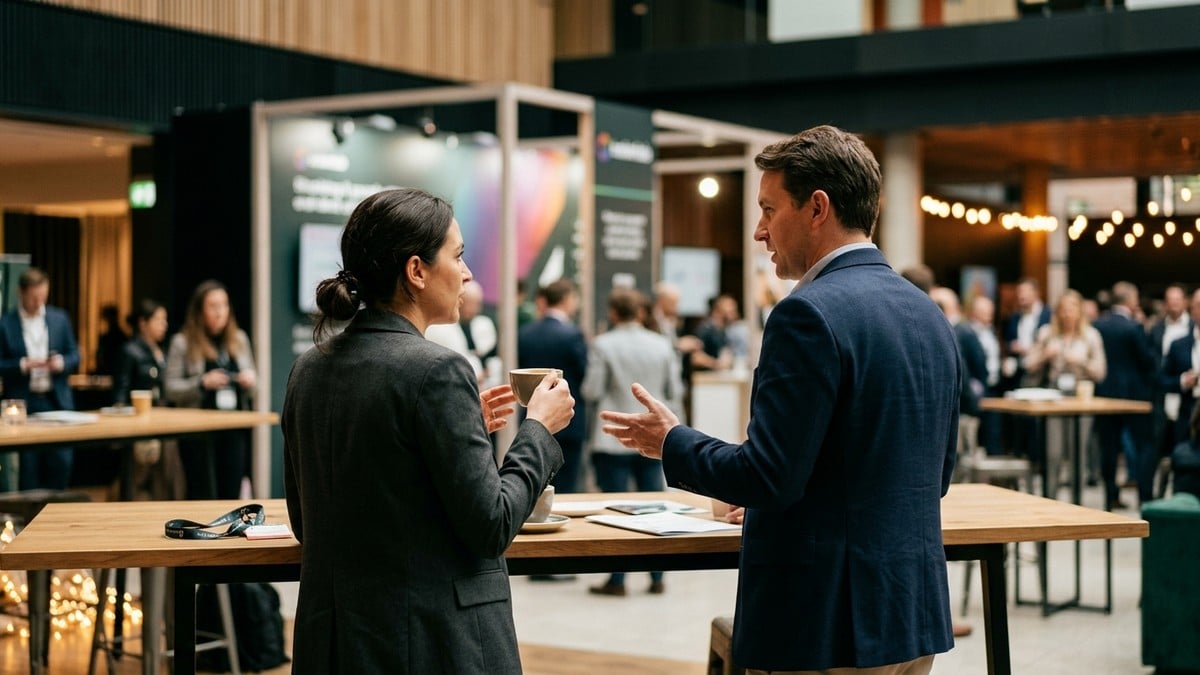
The badge scan is the lowest-value piece of data you collect at an event. It tells you a body was at a stand. It does not tell you what they asked, what they were looking for or whether they had buying authority.
Cox's data shows that visitors who spend more than three minutes at a stand, or who come back for a second visit, are several times more likely to convert into post-event pipeline. Dwell time and repeat visits are stronger predictors than total scan count, full stop.
The other piece exhibitors usually fail to capture is the conversation itself. A common pattern we see at corporate events: a rep has a five-minute booth conversation with a senior buyer, scans the badge, and by the time they are back at their desk a week later, the only thing left is the name. The fix is operational. Every lead capture should include three pieces of qualitative information alongside the scan. What did they ask about, what problem are they trying to solve, what is their timeline. Without those three fields, a scan is just a name in a spreadsheet.
Hire Space Top Tip:
Brief every booth and stand staff member to log three things alongside each scan: the topic they asked about, the problem they mentioned and any timeline they indicated. Three fields. One line. Done at the booth, not from memory a week later. This single discipline will improve your follow-up conversion more than any new piece of event technology you could buy.
Post-event: sort, do not blast
The standard post-event motion is to push every scanned badge into a generic nurture sequence. We have seen cases of one event team sending an attendee 90 emails in the three months after a show. Whatever return that event was meant to generate, it died somewhere in the middle of that inbox. Email fatigue erodes the very ROI the team was trying to demonstrate.
AI-led sorting changes the maths here. Cox cites lead categorisation models that classify leads as hot, warm or nurture based on dwell time, repeat visits, product interest and conversation tone. Done properly, this saves exhibitors up to 60% of follow-up time and gives sales a queue that is already prioritised. The point is not the technology. The point is that one generic email to 1,200 leads converts worse than three targeted sequences to 400, 500 and 300.
CRM handoff: where the pipeline actually closes

This is the stage most event reports never measure. Did the lead end up in the CRM with full context. Was it routed to the right account owner. Did the salesperson have the booth conversation, the pre-event registration data and the on-site behavioural signals in one record before they made the call. If any of those answers is no, the event team has done its job and the company still loses the deal.
The pattern across the field marketing teams we work with is consistent. The ones whose event budgets survive board review report pipeline back to revenue with attribution: deals influenced, deals accelerated, average value. The ones reporting attendance numbers tend to be the ones whose programmes get quietly killed nine months in, regardless of how well the event itself ran.
The retention dividend nobody talks about
Cox shared a quieter stat in her London session that is worth more attention than it got. Trade shows where organisers actively encourage exhibitors to capture leads, with the right tools and the right framing, have a 10% higher rebook rate post-show. Pipeline visibility is not just a marketing metric. It is a commercial moat for the organiser, because exhibitors renew when they can see what they bought.
The same dynamic applies inside corporate events. Freeman's Spring 2026 Learning Trends Report, based on a survey of 4,729 attendees and 185 organisers, found that 83% of organisers think their education sessions make attendees want to return. Only 42% of attendees agreed. Across the industry, only 27% of attendees actually return to the same event the following year.
That gap, between what organisers think their sessions are doing and what attendees actually experience, is where retention pipeline leaks just like sales pipeline does. The fix is the same. Measure the outcome, not the activity.
The buyer-centric flip
The most useful framing from the Event Tech Live Sales 3.0 panel came from Raoul Monks. The high performers in B2B sales, the 14% who bring in 80% of the revenue according to the Epsilon Pavilion benchmark he cited, do not start with "what did we sell." They start with "did our customer win." That single switch reorders every step of the workflow above.
- Pre-event registration becomes "what is this person trying to achieve at this event."
- On-site capture becomes "what conversation moves them forward."
- Post-event nurture becomes "what content helps them do their job better."
- CRM handoff becomes "what does the salesperson need to know to be useful, not pushy."
This is a workflow change before it is a tech change. The technology, AI sorting, real-time dashboards, predictive engagement scoring, makes the workflow scalable. But the workflow has to exist first.
A practical follow-up checklist
For corporate event teams running quarterly or programme-style events, the changes that move the 79% number most quickly are operational, not technological.
- Cut your registration form. Drop "how did you hear about us" and any field that is not actionable. Replace with one or two commercial-intent questions tied to your sponsors' or your own audience priorities.
- Brief booth and stand staff on context capture. Every scan needs a one-line note. Topic asked about, problem mentioned, timeline indicated. Train this in.
- Set a 48-hour rule for CRM entry. Every lead with context, in the system, routed to the right owner, within two working days. Anything later is functionally cold.
- Build three nurture tracks, not one. Hot, warm, nurture. Tone, cadence and content differ for each.
- Report pipeline, not attendance, six months later. The number that proves the event worked is the deal value attributable to it, not the scan count on day two.
- Feed it back into the next event. Which sessions, sponsors and topics drove the most converted pipeline. That is your brief for the next agenda, not last year's attendee feedback form.
What this means for the rest of your event programme
Most of the conversation about event ROI in 2026 is happening at the wrong altitude. It treats measurement as a reporting exercise to satisfy a CFO. The teams that are winning are treating it as an operational discipline that connects pre-event intent to post-event pipeline through a workflow that can survive a busy week and a lean team.
The data Sarah Cox flagged is sitting in your existing tools right now. Registration forms, badge scan logs, app behaviour, session attendance, post-event surveys. None of it is missing. It is just not connected.
Connect it, and the 79% figure starts to come down. Leave it, and your event is paying to generate pipeline that someone else, somewhere down the line, will quietly write off.